- What has this contribution inspired/influenced in the field of typography?
One of the designers that El Lissitzky inspired was László Moholy-Nagy. When Lissitzky visited Germany in the early 1920s, he inspired Moholy-Nagy, along with members of the De Stijl group, to embrace constructivism (László Moholy-Nagy, Painting and Photography, 2014). As a result, pure geometric forms were used in Moholy-Nagy’s pieces to express his core values: he would also experiment with balancing opposites, such as those in value (black and white), movement, and the two dimensions (horizontality and verticality) (Alarcó, n.d.).
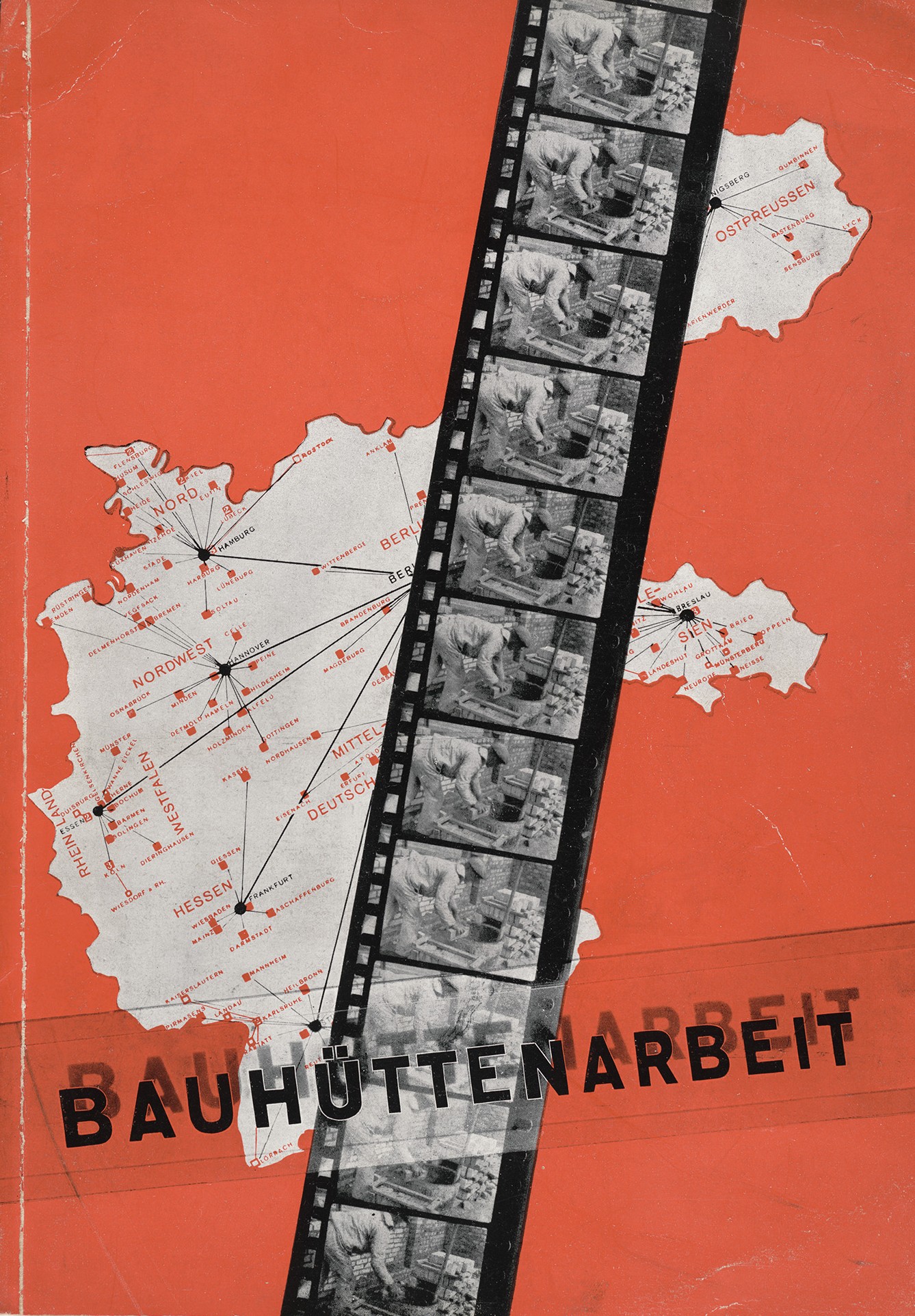
In this work of Moholy-Nagy’s (to the right), which was the cover for “Work of the Building Guilds,” (Moholy-Nagy, n.d.) he uses aspects of Lissitzky’s style: he uses Lissitzky’s signature color palette of red, white, and black; he places each visual element on a strong, structured diagonal axis; and he uses repetition with the line of film. The only aspects of Lissitzky’s style that weren’t employed were the use of simple forms and message amplification of written text through visual elements—although he did amplify the message using the roll of film and map of Germany, it isn’t quite as strong as in Lissitzky’s work in which the visual elements directly mirror the written text (Beat the Whites with the Red Wedge).